
The original Scribner log rule was based on diagramming the number of boards (one-inch thick, with allowance for slabs, edgings and saw kerf) that could be recovered from a log of a given diameter and length. The board foot volume was then determined by totaling the volumes of all the boards. The original Scribner log rule has seen modifications over the years, but its “diagram formula” of one-inch boards forms the basis of log scale volumes used today.
Scribner decimal “C” is a modification of the Scribner log rule that uses tens of board feet as its basic unit of measure. It rounds off board foot volumes to the nearest 10 board feet and drops the remaining cipher. For example, if a log scaled 96 board feet by the original Scribner rule, Scribner decimal “C” would round this to 100 board feet, drop the remaining cipher, and express the volume as “10 boards.” Ten logs (each with a scale of “10 boards”) would total “100 boards”, which is the scaling expression for 1,000 board feet.
Throughout the United States, lumber volume is expressed in board feet. A board foot measures 1” x 12” x 1’ (or its equivalent – for example: three boards, each with dimensions of 1” x 4” x 1’, would equal one board foot). The formula for determining lumber volume in board feet is:
Board Feet = Width (in inches) x Thickness (in inches) x Length (in feet) / 12
In many instances, the board foot volume of lumber that is produced from a log does not equal the board foot volume expressed by the log scale. When the amount of lumber actually recovered is more than the amount predicted by the log scale, it is referred to as overrun; if it is less than the amount predicted by the log scale, it is referred to as underrun. A formula to calculate the percentage of overrun (or underrun) is expressed as:
“Overrun” (underrun) in % = (lumber tally – net log scale / net log scale) * 100
Differences in scale versus lumber yield are due mainly to the design of the Scribner decimal “C” log rule versus the type(s) of end product(s) being manufactured. Scribner decimal “C” is based on boards that are one-inch thick, actual size. Lumber production is based on various nominal size board measurements. This difference may be illustrated by comparing the Scribner diagram with a sawing diagram that reflects production of “two-by-fours” on six-inch diameter logs:
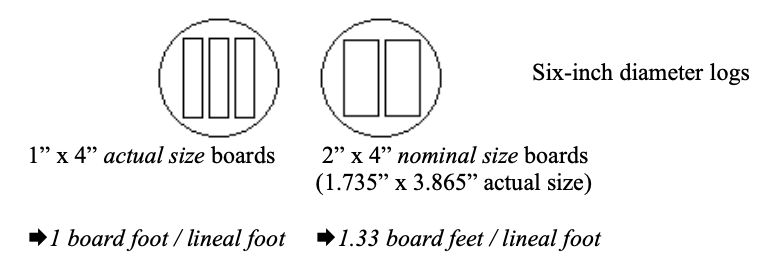
Since lumber products are manufactured in a variety of sizes, the lumber tally in board feet will seldom be the same as determined by the log scale. Veneer, chips, and sawdust are additional products that may be recovered from a log, and require the use of conversion factors to predict yields. Other factors affecting “overrun” (or underrun) include log sizes, taper of the logs, efficiency of milling machinery, and accuracy of the scaler. To account for all the variables would require a different scale rule for each end-product. In the final analysis, scale is simply a standard for measuring log volume whose application is independent of lumber yield.